Gifts of Imperfection by Brene Brown in typical style brings forth a beautiful and chaotic mess that we call real life put forth in a way that encourages us to embrace all of it. Brown challenges our mindsets and behaviors in ways that allows us to step back and see the striving and performing for what it really is. Not having felt this would be applicable to me, I found myself cast into the reality of my own shortcomings and scrambling to embrace them (or more accurately justify my responses to them). Ultimately, this book is a critical component for those on a journey of self-compassion. The beginning is profound as principles are established and hard words are delivered, but about halfway through Brown changes her focus and gives many practical examples and applications that we can heartily embrace.
During this time of Covid-19, I’ve read many things by well-meaning Christians that seem to imply certain behaviors carry the weight of sin behind them. Specifically, I am speaking of compliance or noncompliance to governmental/business guidelines of social distancing, wearing masks, etc. I’ve read articles in newspapers, emails, and viewed social media postings that accuse Christians choosing to not comply with certain standards as committing sin or being poor witnesses.
I am considered high risk during this pandemic and have my own beliefs and responses to the guidelines. But let’s back up a moment, friends. The bible is clear to us about living with love and respect for one another and for our authorities. It does not, however, say that if you don’t wear a mask you are not living in love. It doesn’t say opening your business to feed your family when the government tells you not to will make you a poor witness. If that were the case, no soldier in the American Revolution could be considered a good witness or loving christian for defying their authorities and acting in accordance with war.
Placing a moral burden on behaviors that are not consistent with our own personal beliefs is dangerous territory. Sometimes behaviors are not good or bad, sometimes they simply ‘are’. Trauma survivors of severe abuse may have a difficult time wearing masks due to the particulars of abuse they’ve suffered. Does that mean they do not ‘love’ appropriately? A recovering alcoholic may resist the urge to drink by leaving his home on quarantine and buying paint to have a project. Does that mean leaving his house was nonessential? If someone falls in front of you, are you to cross more than six feet away to avoid helping in the name of love?
Again, general blanket statements about behavior are not wise and should not be taken seriously. Remember, God sees the heart, God is in control, God is bigger than Covid-19. This is not to say we should not respect the space and desires of others or that we should be unwise in our own behavior. But let’s remember that the bible was written with the notion of freedom in Christ. Invoking scripture to support a personal belief or blanket statement is an inappropriate use of scripture.
So, within your own heart, through prayer and your relationship with Jesus Christ, act in accordance with the way the Holy Spirit is guiding you in each moment.
While I am not a professional or expert in government models, I took a different perspective on the models presented for bureaucracy. Rather than see each of the three as complete and individual models I see the weberian model as being the structure of organization within the bureaucracy where the other two models seem to be characteristics of how bureaucracies function (their incentives, motivators, reasons behind the particular culture of the bureaucracy).
So while our current federal bureaucracies are structured very similar to the weberian model, we often see operations and functions take on characteristics of the monopolistic model. In this we see that without competition there is little incentive for the bureaucracies to become innovative, increasingly efficient, thrifty, and well-managed with a focus on service output. No one is going to compete with most of the agencies in our government like the IRS, EPA, FBI, etc. and therefore we see a lot of waste and lackadaisical work ethic. (This is another reason, if I may interject my personal opinion here, that capitalism makes for such an efficient, innovative, and industrious economy. Incentives and motivators are powerful!)
Furthermore, because there is a weberian structure with monopolism at the highest levels there needs to be some sort of revenue and resource flowing into the bureaucracy. Because of this, I can see how upper levels of bureaucracy often function in the acquisitive model of bureaucracy as they compete for budgeted resources and seek to maintain the monopolistic characteristics the entire bureaucracy has become accustomed to.
I did not truly comply with the question by giving any one type of bureaucracy model to describe ours the best. I think that all three are not only applicable but appropriate. I would give as my final answer that we are structured in America as a Weberian model bureaucracy displaying characteristics and actions that comply with the principles of both monopolistic and acquisitive models.
As for the patronage system of filling bureaucratic jobs I see there could be a few ways in which it would be beneficial in comparison with the current merit system. The patronage system would allow for more efficiency due to the majority party being in control and little resistance from bureaucratic workers. The rules and laws that needed to be implemented with indebtedness to the president for their position along with partisanship would invoke a greater unity among bureaucratic workers. Indebtedness and partisanship are motivators for finding solutions to red tape scenarios.
Furthermore, less qualified workers for positions would guarantee the reliance of many on a few. Management could easily operate and push agendas simply by having greater qualifications or by playing on the ignorance of the staff. Of course this does not speak for the quality of work being pushed through the bureaucracy, but we are only speaking here for possible advantages.
Efficiency and nonresistance would assist the president as he seeks to fulfill campaign promises. Congress’s public approval soars when they “get stuff done” I believe the unity and fulfillment of agendas would reflect well on Congress in the eyes of the public as well.
I realize that The Pendleton Civil Service Reform Act of 1883 and the Hatch Act of 1939 address the issue of patronage within the United States. I would suggest that patronage does still occur on a smaller scale. My father worked for the department of transportation, a state level bureaucratic department, and when he ran into trouble with management from the opposite side of the political spectrum they did very little to assist him or keep him as an employee. An alternate with the same position and different jurisdiction ran into the problems and received full support. The bias was evident and I suspect because the top-level positions are often appointed that there is a trickle-down effect. I wish I had an article to share here or some example more concrete of what I am attempting to explain! In the end, patronage is managed well through these acts but it does not mean that it is obsolete in our structure or that we are truly a merit-based system through and through.
References:
Bureaucracies, American Government 2e, OpenStax, Creative Commons Attribution 4.0 International, 2 ed., 2019, ch.15.
I will never forget when I first learned about this in middle school and the sinking feeling it gave me of betrayal! Hearing the atrocities of other countries and the mass ill-treatment of groups of people I had believed that we in America had risen above that and were beyond reproach. Remaining discriminatory practices against race, disability, gender, etc.were simply the residual remnant of the past and would easily be overcome with awareness and time. The new knowledge of American-Japanese (I am deliberately placing the word ‘American’ in front) internment camps created a paradigm shift that opened my eyes to the complexities and contradictions that occurred not only abroad in far away places, but here at home. And worse, many of the adults I spoke to about this after class affirmed the government’s action!
Taking this opportunity to review the case file of Korematsu v. United States, (Korematsu v. United States, 584 F. Supp. 1406, 1984 U.S. Dist.) the circumstances of Executive Order 9066, and particularly the 1984 US Supreme court grant of a Coram Nobis writ (writ of error post-conviction) to understand not only how this happened but whether it could happen again I was disappointed with what I found.
The case quotes the commission created by Congress in 1980, Commission on Wartime Relocation and Internment of Civilians: “”broad historical causes which shaped these decisions [exclusion and detention] were race prejudice, war hysteria and a failure of political leadership.” As a result, “a grave injustice was done to American citizens and resident aliens of Japanese ancestry.” (Korematsu, 584, F Supp. 1406, 1417.) I feel it is imperative to note that while damages were awarded throughout the years following and up until the 1980’s, for many it was too late and too little.
Executive Order 9066,was granted with no evidence and when the case was initially brought before the US Supreme Court in 1944 this information was omitted. “The Commission found that military necessity did not warrant the exclusion and detention of ethnic Japanese.” (Korematsu, 584, F Supp. 1406, 1417.) Therefore, in short, yes, this could happen again by Executive Order.
Our US Constitution states in Amendment XIV, “…nor shall any State deprive any person of life, liberty, or property, without due process of the law.” Being an Executive Order, however, this was beyond state jurisdiction and it fell under Article II of the US Constitution which allows considerable sway in determining the specific permissions of the Executive Chief. The US Supreme court has upheld that all Executive Orders are constitutional.
So while I’ve laid out the clear path of how this vicious order was enacted lawfully, it was also overturned in 1984 and deemed an injustice (albeit largely due to the original Executive Order 9066 being granted with no evidence). Agreeing with this overturning, it is an injustice for the reasons I’ve implied above: civil liberties, civil rights, Amendment XIV and the Due Process of Law clause, Amendment IV, V-VI (specific trial processes), and Amendment IX, “the enumeration in the Constitution of certain rights shall not be construed to deny or disparage others retained by the people.“ It is for these very same reasons that today the same principle should never again happen
Amendment I protects those practicing the Muslim religion with a right to privacy as well as freedom to practice. The Equal Protection Clause of the XIV Amendment protects “all persons”, not only citizens. I do fear, however, that in the “rational and legitimate interest of government” (American Government 2e, 2019.) the justification for violating the Equal Protection Clause of the XIV Amendment may come into play at such a time. If that would happen, what would the limit be, where would the line be drawn to protect us? Would any group be safe? If the government is able to do this we may be living a complete illusionary experience like I did until middle school, believing America faultless. Without freedom, what are we? As Alai Stevenson said, “My definition of a free society is a society where it is safe to be unpopular.”
Summing up my thoughts on this from a 2017 Washington Post article about this historical event: “’Watching the leadership and the politics that go on now it’s a little disconcerting to think that it’s potentially going to happen again,’ Marutani added, ‘Disregard the Constitution, it’s just a piece of paper.’”
References:
Civil Liberties, American Government 2e, OpenStax, Creative Commons Attribution 4.0 International, 2 ed., 2019, ch.4.
Your Last 24 by Kendall Keeler is one of those books that can be read in two hours, processed in two months, yet personal incorporation would take two years! The first book in his Legacy Journal Series, it is a timeless treasure you want to keep a few physical copies of on hand to share. At first, it seems Kendall is restating the obvious, but as each chapter builds we are pulled away from our closely guarded (and often sub-conscience) beliefs about death, God, and self. We are reinserted with a new understanding and powerful perspective and are left wondering how this happened to us! No one will read this and remain unchanged! Stay tuned for a feature with this author on Crutchprints in June!
As I scroll through social media posts and hear stories of various emotional responses to the Covid-19 Quarantine, I have been surprised to be confronted with an aspect of isolation I had not considered. It never occurred to me that limiting social contact would have a profound effect on so many. Even with the presence of technology, there are a lot of threads quarantine is tugging at, threatening to unravel garments.
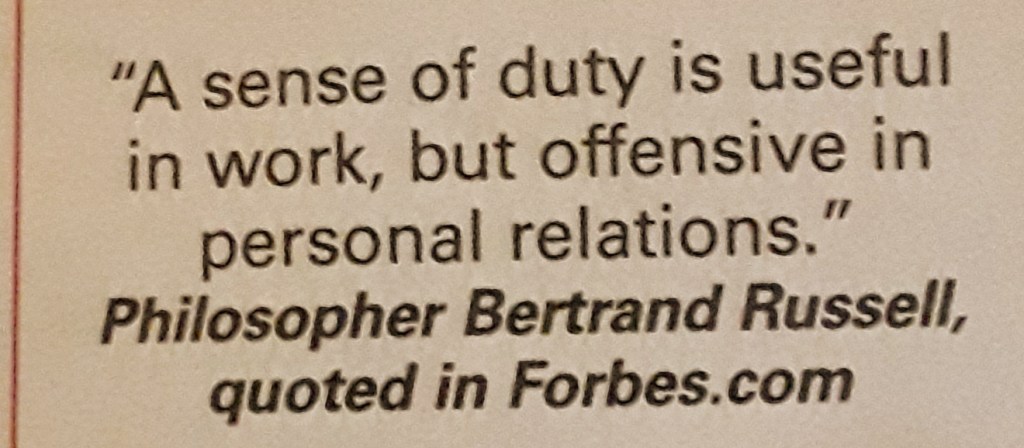
The duty of social distancing is tough
I see a hundred humorous memes posted each day describing the way quarantine and isolation drives us to drink alcohol, I hear of people hiding in their closets for personal space, the bitter argument over what constitutes an essential business continues, and I see women pulling their hair out trying to homeschool. Many are juggling the added responsibility that accompanies 24/7 childcare with work-from-home dynamics. Restaurants are closed and everyone is cooking three meals a day causing an influx of “what the __ do I make for dinner”, “where can I buy ____”, and “when is unemployment coming” posts. Many sites are brimming with the honest posts of those struggling without therapist interaction, access to activity venues, or other typical escape routes.
My first response to all this was: This is how elderly and disabled people live constantly, with no end in sight, what’s the big deal? Quarantine will end, the pandemic will eventually come to a grinding halt, life will resume for most people. But those that are elderly and disabled will continue on, dwelling in the isolation they have known long before this outbreak. Elderly and disabled often have limited mobility, causing social interaction to be at the mercy of technology or the good graces of those that choose to make an effort. This has become a way of life that many elderly and disabled have had to adapt to over the years, often begrudgingly. After all, what choice have we had?
For me, this pandemic has highlighted an aspect of disability and elder care that hasn’t garned attention in times past. As I observe the mental health impact this quarantine bequests on people that are otherwise completely healthy and have no disability or mental health concerns. If being stuck at home and under stress has this much of an impact on people of full capability, sending many into a state of chaos, anxiety, and depression, how much more would limited interaction affect a person that in addition to long-term endurance of quarantine-like conditions also struggles with some sort of physical or mental health issue?
God created us as social beings and this is not only displayed in scripture but reinforced as science addresses mental well-being. The smallest social interaction has an enormous impact on well-being, even when we do not think we need it. I listened to an interview with Nicholas Epley recently, social psychologist and author of Mindwise: How We Understand What Others Think, Believe, Feel, and Want. (Epley, N. (2014). Mindwise: how we understand what others think, believe, feel and want. London: Penguin Books.) In various studies Epley found that when our intuition is for solitude, it is often incorrect. In each controlled study they discovered even when people thought they preferred solitude and silence on public transportation systems they rated the satisfaction of their experience much higher if they socialized. The type of conversation didn’t matter, whether the person was a stranger didn’t matter. In the interview with Laurie Santos, Yale University Professor, Epley described another situation where a railroad corporation surveyed customers and found customers claimed to desire solitude and silence during commute times. But when a rail-car was opened for social hour it had to be shut down due to overcrowding! A fact that had Epley place his hands on his head, shaking it. Another clear example of ways that our intuition can be often incorrect.
In the first lecture of Yale University course Science of Well-Being, Professor Laurie Santos addresses what she calls the “G.I. Joe Fallacy”. (Science of Well-Being is the most popular class in the three century history of Yale, and as of March 2020 during Quarantine more than 600,000 students have signed up to take this online free course.) (Santos, L. (2018). Coursera. Retrieved 2020, from https://www.coursera.org/learn/the-science-of-well-being.; Hathaway, B. (Mar. 25, 2020) YaleNews. Retrieved May 4, 2020, from https://news.yale.edu/2020/03/25/housebound-world-finds-solace-yales-science-well-being-course.) Santos describes the G.I. Joe cartoons from the 1980’s that ended with a moral lesson for children such as street safety. These blips always ended with G.I. Joe reminding us that, “knowing is half the battle”. It turns out, however, knowing is not half the battle, and that is the fallacy. In our minds we often know that we want to be alone, or that we won’t feel better being around people. Science has proven otherwise. Now on the flip side of this coin knowing that we must be socially involved doesn’t help unless we actually implement socialization even when we don’t want to. This may mean smiling on the subway and talking to the person across from us. It may mean making small chat with someone in the locker room, a cashier, or putting our phones away during dinner. Whatever it takes to increase social connection can be done to increase community well-being and personal happiness.
Empty shelves weeks after Covid19 Quarantine
How does this apply to elderly or disabled people spending an inordinate amount of time alone? Put simply, social connection is that much more important for them. There may not be studies on this available yet, but the existing data certainly contains implications. The truth is, disabled and elderly people are often thought of in terms of ‘need’. If there is a need for food, water, transportation, medicine, it will be met. It may not even occur to a healthy person to ask if their disabled or elderly friend or neighbor needs a social call. Likewise, it may not occur to someone that is disabled or elderly that a social call would be considered a need. After all, don’t they feel like they bother friends and family enough with other needs?
The thing that amazes me about science and behavioral health is the way new data reinforces biblical principles in place for thousands of years. For example, there is a Jewish custom, Havruta (fellowship), where study and learning must occur in pairs, never alone. (Schulz, R G. (n.d.) Havruta: Learning in Paris. Myjewishlearning.com. (last visited: May 4, 2020).) The idea here is that iron sharpens iron; the enrichment of education is through interaction with peers. (Proverbs 27:17.) Bryson Katele also makes a great point when he describes the togetherness of Christians to be not a luxury or a devotional, but a necessity. (Katele, B. M. (2003). Fellowship: Its Meaning and Its Demand. Ministry. June 2013. Retrieved from https://www.ministrymagazine.org/archive/2003/06/fellowship-its-meaning-and-its-demand.html.)
“Let us consider how to stimulate one another to love and good deeds, not forsaking our own assembling together, […] but encouraging one another; and all the more as you see the day drawing near.” (Hebrews 10:24-25.) Social connection is a key element of who we are created to be. There are so many differences in the world – differences in abilities, opinions, beliefs, habits, interests, careers, etc. But right now, we have one thing in common: Quarantine. We all share together and stand together in this, but when this is over what will bring us together then?
I’ll tell you: We are humans that need social connection. This unity isn’t applicable only to times of quarantine or crisis. When life goes back to revolving around four spinning wheels and busyness, let’s remember how isolation impacted us and the people around us. Let’s remember how isolation sent the most stable of us into a state of chaos and how the most vulnerable seemed so steady. Let’s remember the sacrifice of millions of healthcare workers putting their lives at risk, realizing lives were depending on their social connection. Yes, when things return to a new normal let’s take a few moments to pause for a visit with an elderly or disabled person near us. They need it, and, it turns out, so do we.
There are both advantages and disadvantages of America’s many levels of subnational governments. Subnational governments allow for a more tailored approach to law in various geographic locations. Laws that are needed for snow removal or Amish buggies in PA are not really relevant in AL, for instance. It is very difficult to take one cookie-cutter approach and apply it to a land as vast as America, so most of the mundane and task-related laws being handled on a smaller scale has greatly benefited our country.
Preservation of tradition, culture, and society is another advantage to smaller subnational governments.Certain land and areas should be preserved more than others and a subnational government can provide services according to specific needs. An agricultural area may reflect subnational services that protect farmland, restrict building, and provide certain services to farmers or the community such as allowing firearms, hunting regulations, and permitted burning. An urban location may provide equal housing services, encourage building with subsidies, various social services, and yet not allow open burning or permit handguns in city limits. A community with a majority of catholic believers may find government services and tradition protecting and permitting religious parades or community events while also protecting the rights of those against birth control to receive medical services during pregnancy. These are very vague and probably unrealistic examples but they do present the point that subnational governments have access to addressing the more specific needs of people in a way that the federal government cannot provide in “blanket” laws.
Subnational governments also can enact laws that can be experimented on a smaller scale before being pushed up to a national level. It gives a more controlled environment to see what sort of effects will stem from political action and legislature prior to mass implementation.
While America is are set up as a federation with the People in charge of the national and subnational governments (retaining equal status and power), the reality seems to be that we are moving towards a unitary system of national government centralized and retaining more power over state governments. I feel even the Supremacy Clause in the Constitution enforces this viewpoint of a unitary system. As transportation and technology advance in America the vastness of our land shrinks and we become more unified. It is natural for our governmental system to line up with those advances.
This highlights one disadvantage of many subnational governments: conflict. The laws are different within each government, each jurisdiction, each state and county even. Laws in many places will conflict laws in others. In PA we can carry a firearm with a permit and DE will recognize that permit. However MD will not so if we go visit my husband’s father in DE with a handgun and carrying permit (which we don’t) and we plan to cross through MD to get there (which we do) we would be operating illegally in MD and a routine traffic stop could expose that. So in a tri-state area like I live in it is important to always remember that each government has a different requirement. This is not convenient for many reasons and as we all have heard “ignorance of the law is no excuse” but to sort through each state’s own guidelines on every subject can be impossible.
Confusion is another drawback during elections and voter awareness/participation. I was really appalled to realize that state senators and US senators are NOT the same thing. How did I not know that? I’m still confused by the whole thing, honestly, and trying to figure out who I voted for and what I may have done unwittingly! Surely if I do not understand this there are others also confused. Aside from this there is confusion regarding concurrent powers such as taxes, courts, law enforcement, etc. Concurrent powers make it very simple to “pass the buck” around rather than having any one government assume responsibility and fix problems. I believe this is one cause of a lot of red tape.
Our founding fathers set up the subnational governments and representatives with the specific intention of maintaining that constituents remain a priority. It is for this reason that they felt the US House of Representative members should have much shorter terms than US Senators. The thinking was that in order to properly represent a people constantly multiplying and changing, and to prevent tyranny, it was necessary to impose shorter terms on those closest to the people. The same can be said in regard to term limits. The changes in offices held by members does allow a more fluid representation of constituents.
In all honesty, I feel that the US has too many subnational levels. I think that a Federal and a State level with an expanded state bureaucracy would suffice. Municipal, townships, boroughs, etc.do create confusion and disadvantages for citizens. It influences where people live (tax rates), what the quality of life and poverty rate is (cost of living), and feeds the sociological conflict theory of an elite society run by elites for the elites while keeping others down. There are too many jobs being repeated across these subnational governments and I believe tax dollars could be stretched a lot further if there was a more centralized approach.
Term limits seem to have more solid disadvantages due to the statistics which reflect that limits do not increase diversity or experienced legislators. Without experience or institutional memory legislators turn to relying on lobbyists which typically provide only one solidly bias perspective. While the Federal government has many agencies and committees filled with experts along with nearly unlimited funding, states do not have that advantage on the same scale. Without the funding and expertise being provided to state senators and legislators there may be a real advantage in a long-term post. A long term post would allow expertise and knowledge to be gained steadily over the course of years since there is no central committee to continually educate each new member of the house.
In our modern world it is not reasonable to expect any person to give up his/her career for a two year term with no guarantee of re-election and includes a term limit. Income is no longer earned by primarily farming and providing for our own individual/familial needs. Most people work and rely on a paycheck to purchase the goods that are needed, and the longer an employee works for a company or in a profession the higher their income. So term limits provide quite a wall of opposition which prevents many qualified candidates from wanting to run for office.
One of the disadvantages to term limits is the creation of safe seats which are created through gerrymandering laws. There are things that can be done to remedy this without term limits. What I propose, is not strictly a “yes or no” to term limits but rather an expertly equated term limit that is longer than 8 years but less than 20. I’m sure there is a nice round number in there that brings the best advantages of both arguments into balance. Diversity, fresh perspective, seasoned members, educated members, institutional memory, accountability to constituents without too much focus on campaigning, etc.
References
American Federalism, American Government 2e, OpenStax, Creative Commons Attribution 4.0 International, 2 ed., 2019, ch.3.
State and Local Government, American Government 2e, OpenStax, Creative Commons Attribution 4.0 International, 2 ed., 2019, ch.14.
Madison, James. Federalist No. 53. The Federalist Papers. “The Same Subject Continued: The House of Representatives.” New York Packet, NY (1788).
My husband came across a motion-sensitive light bulb recently and purchased it for trial. Whenever I walk into the kitchen I must stop, remove my arm from my crutch, turn on the light switch, pick up my crutch, proceed. The same process occurs when I leave the kitchen. Sometimes I cheat and try to hoist my elbow and crutch to hit the switch and the beat up paint around the switch was attesting to this and looking quite rough, so I was willing to give this new bulb a try.
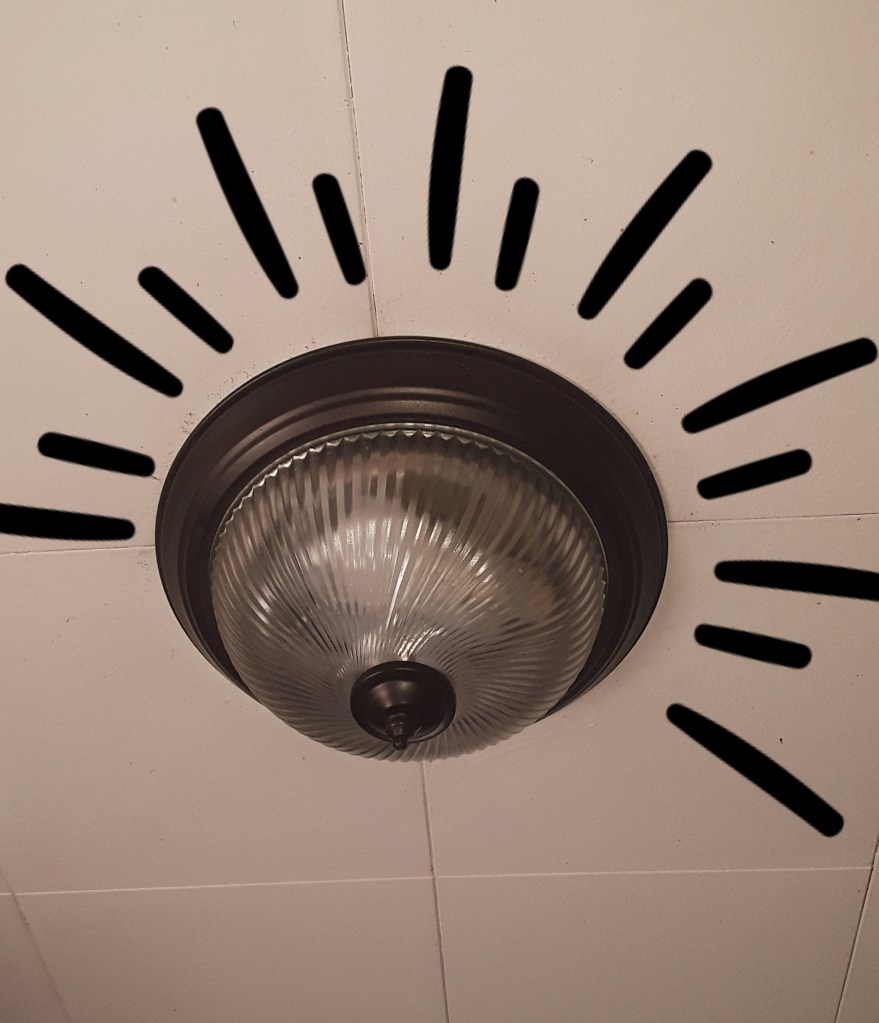
Motion Sensor bulbs work through this basic ceiling light cover.
He put it in the ceiling light with a tinted, textured, glass cover and we were both certain the bulb would not detect motion through the cover but lo and behold it does! Each time I walk into the kitchen the light automatically comes on and three minutes of zero detection will turn it off.
One thing to note, however, is that the light switch must be on in order for the bulb to work and detect movement. So each evening at dark we do hit the switch into the “on” position one time and leave it there until bedtime when we turn it “off”.
This also works in lamps, but the lamp-shade or globe may impact function depending on many factors including height, transparency, location, shape, etc.
Each time a person that is disabled saves a step, saves a stop/start, we preserve our energy and capacity and longevity long term. So do yourself a favor, get one of these motion sensing light bulbs that are found in the light bulb aisle at walmart or any other hardware store. The extra two dollars is worth your body and the stress relief.
*Please remember when considering these recommendations for yourself or a loved one:
a) Ashly is an amputee at nearly the hip level of her right leg; b) Ashly is on crutches or in a scooter 100% of the time; c) Ashly has been an amputee for thirty years; d) Ashly is still young and active in her thirties; e) The crutches that Ashly uses are forearm crutches; f) What works for Ashy may not work for you; g) Ashly receives no incentives, gifts, or compensation for reviews, advice, or mention of any product or company in these features.
*Product, person, and organization endorsements and reviews are not compensated, neither are they to be interpreted or considered as professional, legal, or medical advice. Neither Crutchprints.com nor Ashly Ash has interests, holdings, political affiliations or other ties with persons, corporations, or other entities referenced. Neither Crutchprints.com nor Ashly Ash has received free product(s), sample(s), or compensation(s), or service(s) for postings unless otherwise disclosed. **All recommendations and advice that are posted on Crutchprints.com will be based strictly on personal experience and opinion and should not be taken or interpreted as legal or medical advisement under any circumstances.
A pin given to me by my Godmother to remind me of the perseverance of honeybees
With hindsight being 20/20, I feel that the Bill of Rights was a necessary amendment to the Constitution. There are so many social issues today that are only cleared up by these amendments that I daresay our struggle for freedom would be much greater.
I do wonder, however, if the Bill of Rights had not been incorporated within the Constitution if the interpretation of social issues the Supreme Court has ruled on would be the same? One of the concerns of the Federalists was that by including a list of restraints on government they would also be including implication of permission for the government right to do everything else. Therefore, the way the original document was drafted makes the assumption that the government can do nothing except what it is given explicit instruction to do.
Without the Bill of Rights I wonder if that opinion of assuming the government was “completely limited except for…” rather than “free to do what it wants except for…” would have prevailed? Would many of the social issues we face today be dealt with on a state level? I consider the state level for many social issues more appropriate because as the Anti-Federalists pointed out we are a vast country with different cultures, ideals, beliefs, and all of those things are affected by location. To have laws appropriate for these individual locations would be beneficial. We would not excpect the beliefs and laws of the French to be the same in Spain, would we? Fundamental law differences by state would not have worked, ultimately, as the Fugitive Slave Clause demonstrated clearly. Or in the very least, America would not have remained a unified world power for so long.
Like I said at the beginning: hindsight is 20/20 and it was necessary because the Amendments 14-16, along with the Emancipation Proclamation, were more clearly defined with the solid layout of what it means to be a citizen of the US in the Bill of Rights. With an accurate “checklist” of citizen rights in place it was much harder for anyone to argue that a slave, an African American, or a woman, was not a citizen of full rights. I recently visited the African-American Museum in Liverpool and found written arguments in the display that allude to the “rights” of American citizens and how those rights could not be extinguished for one based purely on the color of his skin. It seemed unfathomable to the English that it wasn’t so easily resolved in the American mind. The idea of Americans having certain rights in a clear and defined document made those rights concrete for reference generations later and the freedom of many.
So ideally, no we would not have needed the Bill of Rights and our government would have known it had no permissions except those we gave it. But being our country was already in the throes of destroying an entire race of human beings and suppressing the female gender, I believe it was very necessary to incorporate the Bill of Rights for the future of America.
I was challenged in February to think creatively about my personal journey and capture that in a selfie. I’m not a very abstract thinker but a few days before the deadline, I walked out my front door and right in front of me was the most starkly green, out of place, ugly weed I’ve ever seen. Not only did I not understand how it got there or how it was even alive in the middle of February. I moved on with my day, but my mind kept coming back to that ugly foliage until I decided annihilation was the only recourse. Right as I plunged my fingers as deep as I could in the dirt to get all of the roots, I had a thought: This is what my journey is like.
Most of us know that the bible begins with a garden, but did you know it also ends with one? There isn’t much that happens to us that we cannot find a parable for in the allegory of a garden, and I like to ruminate that God did this intentionally. He started with the garden of Eden, a place where he wanted there to be relationship (with himself and others), fruitful living, and abundance. This is all lost, we learn, after sin enters the world. But God never gives up, all through history his hand is present and strategically arranging countries, people, journeys, and even our own lives as he toils towards the second Eden.
When I pulled the weed out of the dirt that cold and gray, February afternoon, I didn’t get all of the roots. Ugh, that means it will come back again, I thought. Weeds always seem to pop up, surprising us, even when we already know they will come back. We will weed our gardens and flowerbeds then go about the merriment of life and somehow are still surprised that suddenly there are weeds all throughout the garden again. It is a continual job for one who gardens, and one that varies from garden to garden.
upload via cloudHQ
Some gardens embrace what another garden would consider a weed. Milkweed, Purslane, Morning Glories, Dandelions, Chickweed, Creeping Charlie, and other plants that are beautiful in a meadow and belong there, are considered weeds in my flower and vegetable gardens. We, as gardens, are unique in our purpose; we are each knit together by our creator in a unique way. The plants in my garden are not necessarily in yours, and vice versa. Some doubts and fears and thoughts spring up like weeds in my garden but those very same thoughts may not plague yours. It is important, therefore, for me to know my own garden and what I am growing. I must know where I am planted, recognize the plants I want to keep in all stages, and recognize weeds before they take hold. Our gardens have plants that are annuals (must be replanted annually) and we have perennials (plants that come back on their own each year), which ones do we want to keep?
When we pull weeds out of our gardens, they always look so fresh, neat, and manicured. Flowers begin to thrive and new seeds can take root in the space provided. Free of weeds, plants push forward into the sunlight, striving to burst forth joyful blooms. The beauty and hope that accompanies a garden always inspires a gardener to nourish it lovingly with fertilizer and plenty of water. The care we invest in our gardens require hours, days, weeks, months, and at times years of dedication and commitment. Yet if you speak to someone that loves gardening the whole process, to them, is a delightful one. There is no start or finish to a garden, only cycles. Gardeners love the harvest, relish the planting, enjoy splitting and moving plants, and pruning existing ones. They enjoy seeing the earth turn cold and brown with unique textures knowing that the rebirth each spring is a miracle to behold.
You will be like a well-watered garden, like a spring whose waters never fail.
Isaiah 58:11(b)
But how many of us spend the same amount of dedication and commitment to address our lives as if we are a garden? Maybe God gave us gardens to remind us that we must be tended constantly in order to grow under his green thumb? Do we ensure that we maintain proper lighting, enrichment in soil, and nourishing water? Are we careful to rid our gardens of the weeds popping on a continual basis? Do we diligently manage the boundaries of our garden and keep away toxic things and animals that will destroy it? Do we invest the time in our own self-care that we need to properly flourish?
Are not five sparrows sold for two pennies? And not one of them is forgotten before God. Why, even the hairs of your head are all numbered. Fear not; you are of more value than many sparrows.
Luke 12:6-7
For many, weeds spring up in the form of thought patterns and fear. Those fears and thoughts when watered alongside our flowers will grow stronger and eventually choke out the good plants that we want to keep. It is important to recognize weeds of fear in our garden because they motivate our behaviors, impact our relationships, and suck up all the nutrients that we need. Shameful thoughts of never being enough, never having enough, not being worth enough are also weeds. The Gardener of our lives ensured long ago that we will always have enough and that we are always worth enough.
No matter how many times a flower fails to bloom, we don’t ever blame the flower, do we? Instead, we question other factors: where is it planted, is there enough light, is it being overshadowed, does it get enough water, etc. Yet, when we fail to bloom or when we make mistakes, instead of seeking the wisdom of the Gardener to determine what factors are at play we often heap condemnation on ourselves and beat ourselves down into the soil, wilting and giving up. We dismiss all possibilities of change or growth and collapse or berate ourselves ruthlessly as failures. Other times, weeds of temptation rise up and threaten to surround us/control the way we grow. Weeds, no matter what form they come in constrict our growth and eventually suffocate us.
He has made everything beautiful in its time. Also, he has put eternity into man’s heart, yet so that he cannot find out what God has done from the beginning to the end.
Ecclesiastes 3:11
When winter arrives it is then time to die to old ways, to be pruned for strength, and to embrace a new way. How often do we perceive our hard times as failure rather than success? All gardens that are successful, that are loved by the Gardener, and that thrive go through seasons. They are pruned, sometimes harshly, and then packed with pine needles or another insulating cover, and allowed to rest for the duration of winter. But in spite of the lack of visits, the Gardener has not forgotten the garden! Most of the time, the Gardener sits only on the other side of the window pane, watching longingly and planning for spring. Planning the guiding changes to be made in order for another fruitful harvest, pleased the garden is hunkered down and gaining strength and endurance during the winter months.
He who walks with the wise grows wise, but a companion of fools suffers harms.” & “As iron sharpens iron, so one man sharpens another.
Proverbs 13:20; 27:17
Roughly, the concept of companion planting is that certain plants, when planted closeby, help each other thrive, while other combinations thwart each other. So we must always consider those planted around us and with us. We have plants that are annuals, there for a season, and plants that are perennials which stay permanently. How do the relationships in life spur us on to bloom better each year? Do we have relationships that are annuals yet we keep trying to make them perennials, fighting against the Gardener’s intent? The very first year that my husband and I planted a vegetable garden we planted the cucumbers and the cantaloupes side-by side. It made sense to me, for all the melons to be in one section of the garden. When harvest came, my husband brought in the cucumbers and I excitedly pulled out my cutting board to chop our first homegrown salad. But when I sliced into the first cucumber, it was orange! The second, and third were the same. I tasted, and the center was sweet like a cantaloupe in spite of clearly being a cucumber on the outside. I called my husband, baffled. We walked together to the cantaloupes in the garden, picked one, and to our amazement found it the cantaloupe was a cucumber inside! I had never heard anything like this but a few older farmers chuckled at our naivety, explaining the concept of cross-pollination and told us not to put them together again. (For the record the cantaloupe made a wonderful cucumber salad.) Who are we cross pollinating with, and is that a good or bad thing?
For years I had a problem with thistle weed in my gardens. As I filled my feeders one day I noticed the label on the bag listed thistle seeds among others. I switched to sunflower-only bird seed and while we still found some thistles (I think we never got all the roots!), they have cut back dramatically and I have many pleasant volunteer sunflowers that spring up randomly each year. You see, the birds will scavenge from our feeders and then excrete the seeds in various places. Some of those seeds grow. In this experience I learned it is the job of the Gardener to not only maintain the garden but to consider the aspects of the environment as well! The culture of where our gardens reside is a rural area, farming area, lots of wind, lots of birds, lots of wildlife. As such, I treat my gardens and prepare differently than my friend in a very crowded neighborhood with a small lot. In fact, some of the ‘invasive’ plants she has brought me will not grow here at all in the harsh elements. So not only is it wise to look at what we have going on inside of our garden but we should be informed about what is going on outside of it? How can we help, act in the best interest of, and encourage others with the beauty of our garden? Can our blooms help others? Can the wisdom of the Gardener be shared or a source of hope for others just starting?
There is always work to be done in a garden. And when the garden is complete, well, it will never be complete. There will always be changes and work with each season. So let’s embrace our work and our journey, let’s appreciate the famine and dance in the too-heavy spring rains. Let’s enjoy the toil and sweat on our brow as we pull the weeds, and let’s treasure the hot sunshine that makes us grow. May we let go of relationships that were meant only to be planted as annuals, while taking care to insulate the perennials that will winter alongside us long term. And lastly, may the fresh-cut flowers of our gardens be harvested in abundance. As our flower vases rest on our tables, may the joy we experience come not solely from the display but from working with and for the Gardener.
The last chapter of the bible opens with a most poetic paragraph. This paragraph inspires hope and breeds reassurance that we will again see the garden flourish without struggle along with relationship, fruitful living, and abundance. I find myself returning to this passage over and over throughout my life. In good times and bad, it is reassuring to know that the cycle of my garden will never end in Christ.
Then the angel showed me the river of the water of life, as clear as crystal, flowing from the throne of God and of the Lamb down the middle of the great street of the city. On each side of the river stood the tree of life, bearing twelve crops of fruit, yielding its fruit every month. And the leaves of the tree are for the healing of the nations. No longer will there be any curse. The throne of God and of the Lamb will be in the city, and his servants will serve him. They will see his face, and his name will be on their foreheads. 5 There will be no more night. They will not need the light of a lamp or the light of the sun, for the Lord God will give them light. And they will reign for ever and ever.
Revelation 22:1-5
Spring is right around the corner here in Pennsylvania. The snowdrops are finished, the crocuses are in full bloom, and the daffodils are beginning to litter the landscape with their cheerful faces. I believe my perception of life, gardening, and my personal journey will never be the same again. Having met the challenge, I think I will print this selfie with my weed as a reminder.








 Crutchprints in the Sand